Skip navigation

We are making a 10 gallon starter for our upcoming barleywine in the form of an extra pale ale.

Extract was super efficient and we ended up adding a gallon and 3/4 and still 7 points over our target.

Our plan is to rack our barleywine over the XPA yeast cake.

image

We also enjoyed a few flights of our 6 beers on tap.

image

We bottled six beers for three competitions.

image

We bottled the Double IPA,  Kolsch, Pilsner, English Black Mild, Dunkelweizen, and the Gose.

image

The upcoming competitions are the AHA’s National Homebrewers Competition , the Maltose Falcons’ Mayfaire Competition and the California State Fair’s Homebrew Competition.

Next task is to pack and ship our beers to San Diego for the NHC. 

Win!

We were both able to take a day off from the real world and crank out two beers.

The first is a Gose.  An historical style, we tried a bottle and decided to go for it.  Brewed in Leipzig for a couple of centuries, it has coriander and salt added.  The salt is to replicate the brewing waters of Golsar where the style originated.  We used aciduated malt to sour the beer as well, as we want to enter it in the NHC at the end of the month.

The acidulated malt forced us to do a two stage mash.  One hour without the acidulated and then 45 minutes with it.  We had to decoct about two gallons to bring the temp back up after adding the acidulated malt.  Very long brewing session.

We also used our new sparge arm for the first time on this batch.

image

Our second batch was a problem as we way undershot our gravity.  It was a dunkelweiss that should have come in at 1.050 and barely hit 1.040.  We lost a bit of our first runnings due to an inadvertently open boil kettle valve.  We also may have missed our mash temp on the high side and sparged too quickly.

The recipe is very close to our blue ribbon winning dunkelweiss from last year’s California State Fair.

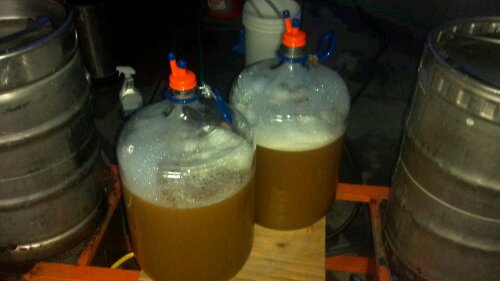
Both beers took off in the fermenters, with the dunkelweiss literally blowing its top, thanks to temperature in the 80’s.

Today’s brew is a double IPA.  10 gallons of beer made with 31.5 pounds of grain.

image

The mash tun is full

image

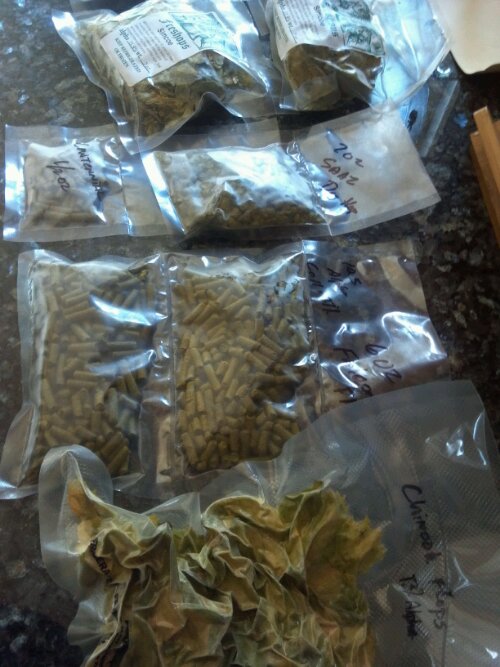
We are using 7 ounces of kettle hops and another six (or more) ounces for hopback and dry hop.

image

Boil-over was a problem again.  Lesson learned:  add hops slowly.

Again, burners have made the day shorter but the power must be respected (see: boil-over).  10:00am mash-in and 1:45pm boil start are the result. 

image

We are giving the Kolsch style another run.  Our last attempt yielded a good beer except for the overwhelming flavor of band aids.  Yes, chlorophenolic hell. 

It was so bad that we dumped the entire batch.  Not fun.

This time was not without drama as we had super efficiency (initial measurement is close to 90%), a yeast that does not want to start and yet another boilover.

Solutions:
The boilover was before the hop addition (low alpha Hallertau) so we did not lose any bittering.  We now have a spray bottle full of water on hand to stop this from repeating. 

The efficiency leaves us with a beer that had an OF of 1.060 when we were shooting for 1.048.  We will add some water to thin it out before we pitch. 

The yeast problem will resolve itself, hopefully, as the starter has been going for only 22 hours.  If not, we buy 4 more yeast units and pitch straight from the vials.

The wort tasted fantastic.   Hoping this one works.

image

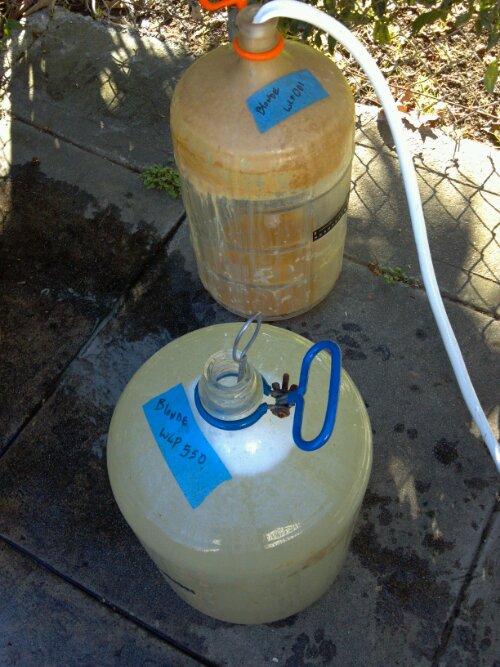
We also spent some time kegging the blonds we brewed last time.  They had a very vigorous fermentation.
image

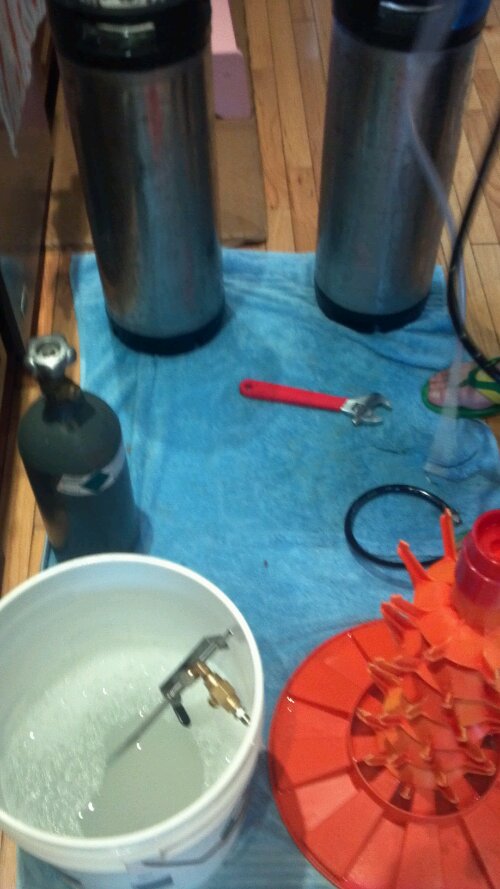
We also spent some of the 90 minute mash and 90 minute boil cleaning kegs and our big fridge.  Strange to see it empty.  

image

image

image

image

We are brewing another batch of blond.  Our first was one of our favorites. Our second was not as good as the first.

Half California 001 and half Belgian 550 yeast. 

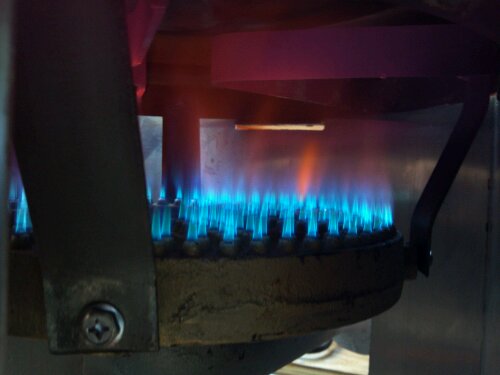
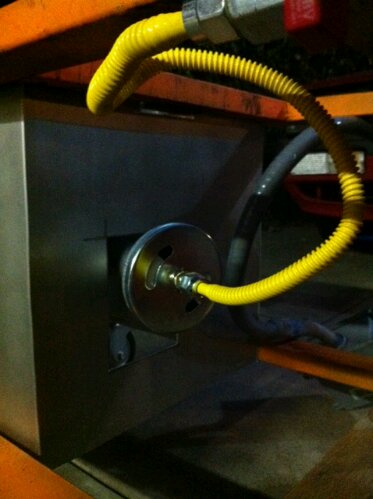
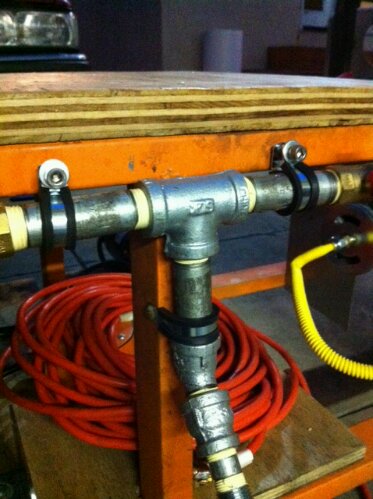
We also swapped our low pressure regulator with a high pressure regulator.   With the new burners we are able to raise 12 gallons by two degrees per minute.  Woo hoo!

image

image

image

image

We decided to use the hours before the traditional Thanksgiving feast to brew a beer.  It had been a month and that feels like too long.

First,  however,  we had to meddle with the brewery.

New burners!

Big banjo style burners were purchased to replace the old high pressure turkey fryer style burners we had before.

The idea was to apply higher and more even heat to shorten the brew day and avoid hot spots in the boil kettle.

Hard plumbing, a nifty manifold and some beefier heat shields complimented the addition.

Just so you know, home brewing is full of fun and promises. We promised to deliver 40 gallons of beer to a party, and that happened. A friend needed a keg for his birthday, no problem, let us look in the back. A special 40th Birthday Wit needs to be made, we’re on it. Family calls, we are men of action.
The latest action comes in the form of a football game. A father in law wanted to show some friends his son in law’s hobby and we are happy to help. With burnout set in from a very busy summer behind the burners, we set out to shorten our brew day a bit, and try some extract brewing. We have not brewed with any extract for over two years and for some reason, were a bit hesitant to do so again. The shortened days and cramped calendars took over and it was time to try extract/ steeping grains again.
A citra pale ale was our target. We started with Jamil’s great book “Brewing Classic Styles” extract  and steeping grains recipe and traded all the hops in on some Citra hops.
The brew day started well, then the problems snuck up on us. We filled the boil kettle a bit too high, still thinking that we were sparging. We swear it looked right. When it came time to dump in the extract, well the kettle almost overflowed. Remember the displacement factor? Nope, not today.  Problem two: Our kettle is set up with a false bottom to help with straining hops. Well, some extract got under the screen away from the stirring spoon and burnt to a crisp. We are still scrubbing the kettle clean. On the positive side, we tasted a sample tonight and you can sort of tell. There is a bit of roast/burnt carmel in the flavor, but not too much.
We dry hopped and took a gravity reading tonight. The O.G. was 1.062, a bit higher than we wanted, and now after 1 week of WLP 001 doing it’s thing we are down to 1.028. Still some more work to be done.

So a little looking around and we found out that a Belgian Wit is much different than we thought.  We had been inspired by New Belgian’s Organic Wit and though that all the tart and spicy was a product of the yeast.  Well, only partially.  Organic Wit is an awesome beer, but a smarter pair of brewers would have actually read the bottle. On the bottle it says it’s brewed with spices. Duh. We were still inspired and not deterred. Time for a brew session.

We started with yet another brewing classic styles recipe. This was going to be fun. Ingredients we had not used before and a mash that called for 2 stops.  The first at 122 degrees and the second at 154.  In addition to pilsner malt, wheat flakes and flaked oats, it called for coriander and orange zest. We added some lemon zest on top of the orange and the wort tasted great.  A pitch of yeast (WLP 400) from a starter grown up from the last wit attempt, worked very well so far, with both carboys staring to ferment after 24 hours. We have read that the WLP 400 might take a little while to ferment out but it is the correct yeast for the job.

One of the smoothest brew days yet we hope will lead to a wonderful Indian Summer beer in the next few weeks.  We shall see.

We are also excited to try some of the beers that we did last year and see if we can brew them better, a second or third time around.

till next time, cheers.


We broke out the hydrometer and took a look at the two different wheat beers that we are fermenting right now. The same base beer, 50% pilsner malt, 50% wheat malt, but two different yeast strains. We tossed in WLP 300 in one and WLP 400 in the other. That’s the beauty of always having to split your batches. We went with a lower than normal fermentation temp for the first week, 62 F, and that was fine for the WLP 300 which was sitting at 1.013 gravity after 10 days. The WLP 400 did not like the lower temp and was only at 1.022. We turned up the temp controler and bam! the whole place went nuts. bubbles from the WLP 400! Huge movement. We are going to brew a proper Wit tomorrow with spices, oats, and all. More updates from the brew kettle.