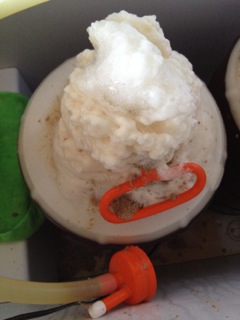
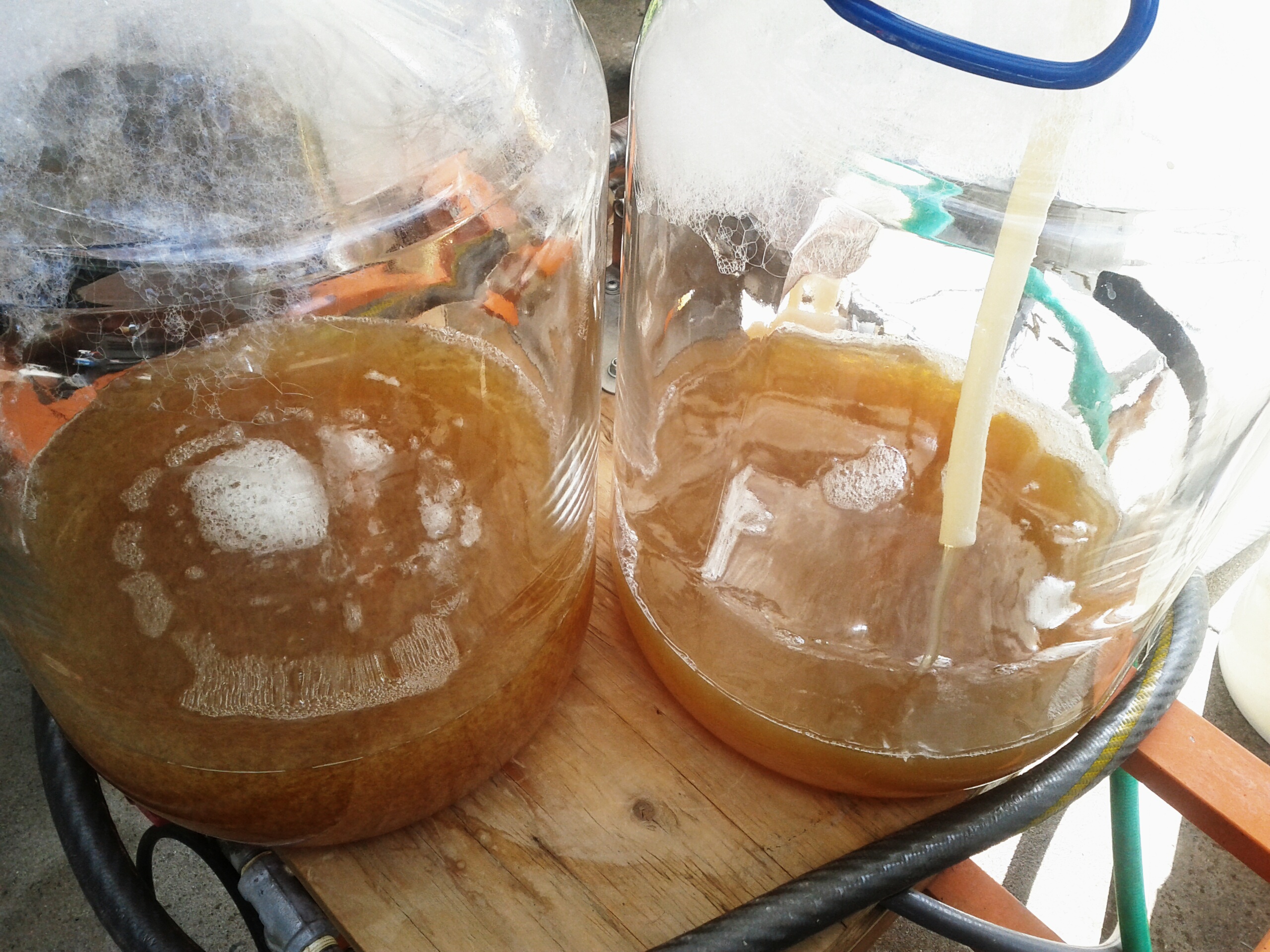
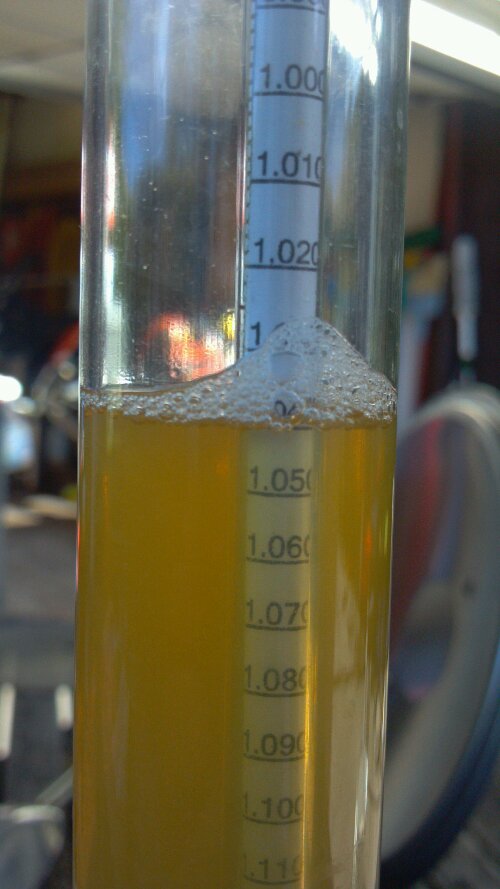
This is what happens when a nice 1.070 wort meets some WLP 001 Cal Ale Yeast it loves. This was after 2 days of fermentation at 60 degrees F.
This is what happens when a nice 1.070 wort meets some WLP 001 Cal Ale Yeast it loves. This was after 2 days of fermentation at 60 degrees F.
Today we are brewing a pale ale and a clone of Ballast Point’s Sculpin IPA.
The pale ale went swimmingly, with absolutely no problems other than a pump issue.
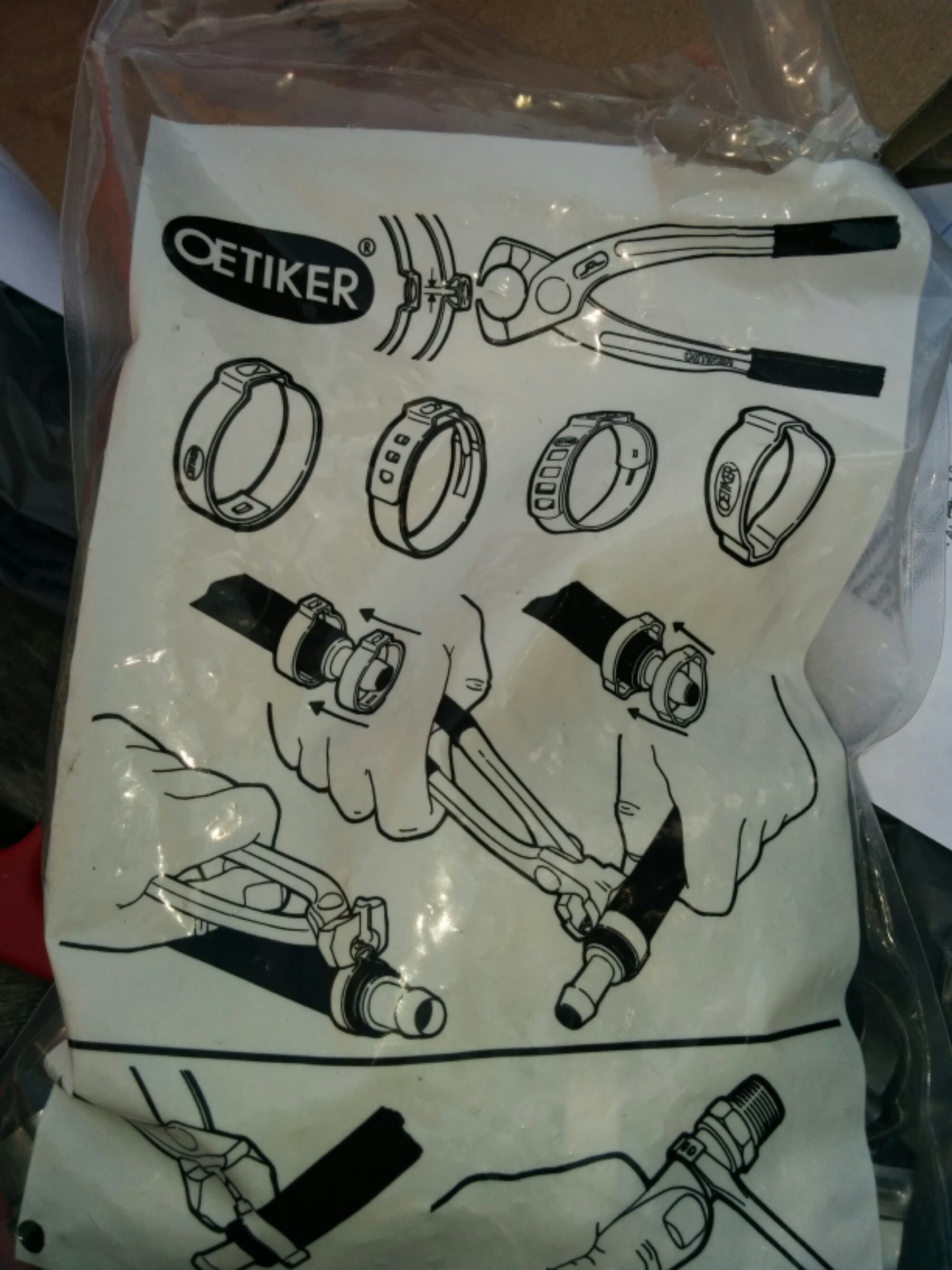
The trouble from our pump #1 was a slow flow.. We took it apart and reassembled it as all looked good. It was sucking in air and we thought it was time to use the Oetiker clamps on our brew rig houses.


We mashed in a couple of degrees above our 148 target for the IPA but were able to get it down with some stirring and leaving the lid off.

We mashed in at the same time we did flame out on the pale ale.
We racked the pale on to our Kölsch yeast cakes (after racking the Kölsch into secondary fermenters) at 60 to 62 degrees.

Racking finished just as we needed the pump to begin our recirculation. We had to wait 10 minutes to clean the boil kettle and fly sparge. Nice 70 minute mash.


The 4 ounces of 60 minute hops are pictured above. Crystal, Magnum, Northern Brewer, Warrior and Columbus. that’s on top of an ounce of first wort hop.
While putting in the hops we checked gravity and found it short by 17 points! No idea how that happened, especially with a long mash, except that in this batch we did not add any 5.2. Weird.
Soon after, we had a boil over and lost a bunch of hop matter. Amateur move…
30 minute hops went fine, except we did not have enough crystal. We substituted a third of the weight with Northern Brewer.
We added some LME and DME at the 15 minute mark to bring the gravity up to target.
Flame out hops and into the fermenters it went. Long day.


We brewed a Kölsch again. Original recipe was used. We missed our mash temp by 4 degrees and struggled to bring it up. Otherwise our brew day was busy but non eventful.

We cleaned a bunch of kegs and the white freezer. One of our kegs had a leak on the liquid side and left an inch of beer in the freezer.

We bought an Oetiker crimp and are going to replace when clamps on our hoses.

We decided to invest a little time and attention to our serving system.
We created a serving “wedge” instead of a “collar” for our larger freezer. The collar is a common way to raise the lid of a freezer to allow kegs to fit inside, and mount faucets to the collar, converting it to a “keezer”. Our freezer is plenty deep enough for kegs so converting it would only add the serving function to what we already have.
We have been serving our beer at a benefit for Children’s Hospital of Los Angeles. We developed a “wedge” to allow us to have the serving function of a collar without permanent modification of the freezer. A simple U shaped wooden structure with a flat face and wedge shaped sides did the trick. A post here describes the old unit.
We simply re-drilled the six holes (to one inch) and installed 3 1/8 inch shanks, faucets that we had laying around, and thirty feet of hose (5 feet each). We finished each hose with a 1/4 MFL fitting, as is our custom. This allows us to attach ball, pin or sanke taps.
Still need to get one more faucet handle.

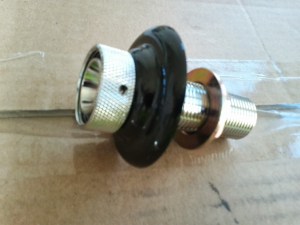
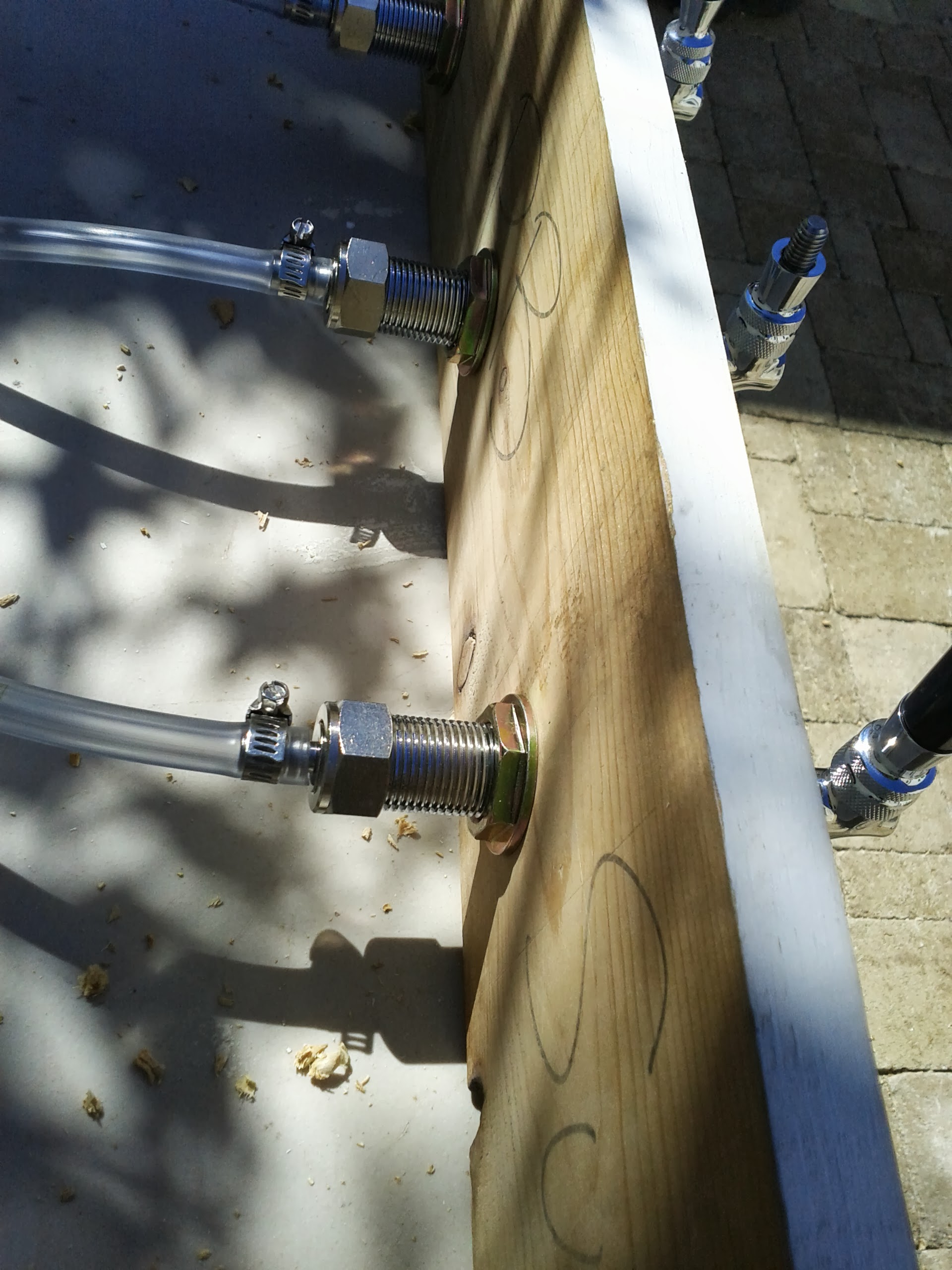


One trick to get the MFL fittings on the hose is to mount the fitting on a tap and use it to get the grip and leverage required to insert the barbed end into the hose.
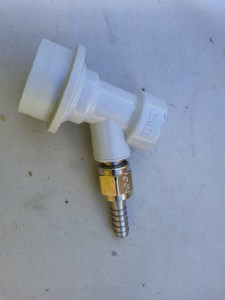
We brewed a double IPA with $85 worth of hops.
Centennial, Columbus and Simcoe to the tune of 28 ounces and 215 IBU. Two row, a tiny amount of dextrine and Crystal 40 make up the grain bill.
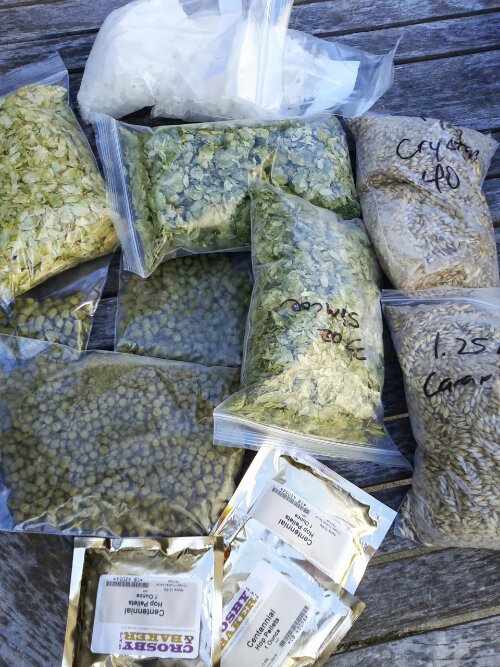
We added 2 pounds of candi sugar to bring it up to 1.069 OG.
We will pitch WLP001 and WLP090 in the two fermenters. We also added Fermencap and Clarityferm as well.
We hit all our numbers and, with a 90 minute mash and a 90 minute boil, it was a very mellow brew day. Only one problem, when carrying one of the fermenters it slipped out of the carrying handle and crashed onto the floor. Fortunately, it was a plastic “Better Bottle” and we righted it with a loss of only a quart of wort.
Two doses of dry hopping lay ahead. Then glorious hop heaven!
We finally got around to brewing an Oktoberfest. Given our modern yeasts and highly modified malts, we should be okay with the timing (but probably should have done this at least a month ago).
We used 23 lbs of malt including a bunch of Vienna as base two other malts that I can’t remember, some caramel 80, a pound of wheat and two pounds of candi sugar (one light and one dark).
The mash was thinner than our usual at 1.7 quarts per pound and we got complicated again with the schedule. Originally designed to infuse at 143, decoct to 155 and then sparge at 168, we ended up with a double infusion and double decoction, We ended up with an intermediate rest at 149 (our decoction calculator failed us).
We hit our original gravity (1.055) exactly. Our ground water was 76 degrees and our Blichmann therminator brought our wort to 78 degrees with a very fast pump.
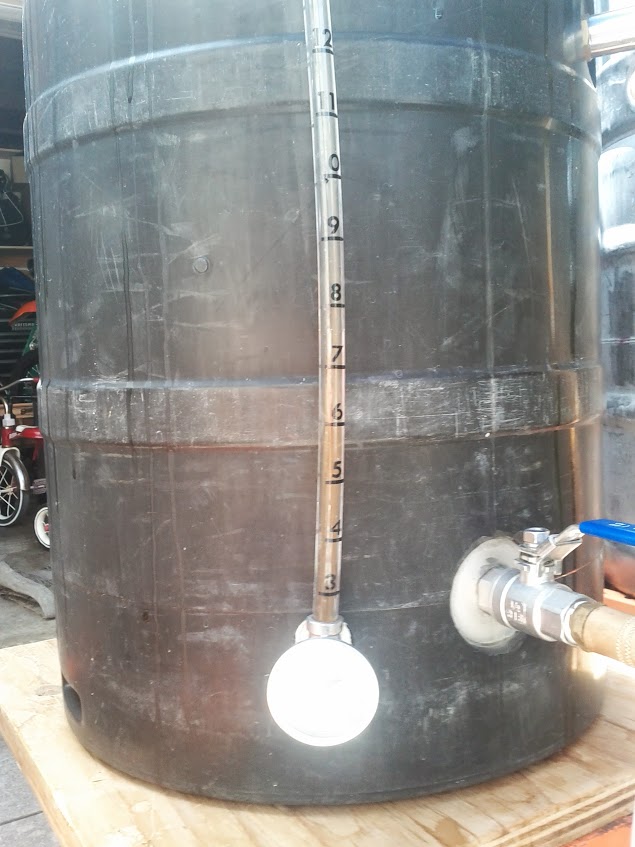
Pretty good brew day (except for our mash miss).
One bummer, however. One of our California Lager fermenters got infected with Chlorophenols. Bad-aid flavor was painful to taste. It was the Kolsch yeast fermenter that went bad. Perhaps we failed somewhere in washing the yeast, cleaning the fermenter or blow-off valve, or some other task. This is the second beer in the past couple of months, and third all time, that has been infected in this way. Time to focus on these issues.

Today we brewed 12 gallons of a California Lager, inspired by Anchor’s version. Ingredients are 23 lbs of two row and 3.5 ounces of Cluster hops. This old school approach is gaining a serious foothold these days. Homebrewers are finding out that simple recipes help you evaluate ingredients and yeasts unlike a more complex recipe. In simple terms, this is a classic SMASH brew, (single malt single hop). We are using a WLP 810 California Lager for 6 gallons and WLP 029 Kolsch yeast for the other 6. We are hoping that a cooler fermentation will help the style and get us to where we would like to be.
It was a simple brew and almost everything went right. However, we were shooting for a 151 degree mash temp and missed low by 2 degrees. Only time will tell whether this will be a bad thing. The beer might be super dry, but who knows, this might be good.
We also kegged our Kolsch and Blond from previous brews. We tasted our aging Berliner weisse (not ready) and our barrel aged barley wine (maybe ready for kegging).
Lastly, we popped open a few bottles from our collection and did a little “quality control.” This was fun…
Most of the beer tasted great and it was great to taste what the judges had commented on all spring and summer.
We even tried some of our Barleywine.

We also received ribbons for three beers we entered into the California State Fair:

We brewed A Kolsch and a blonde on father’s day. The experience could not be more different between the two brews.
We actually measured our grains twice when putting together the mash. We missed our mash temp by a few degrees and had to infuse and decoct to bring it up to target.
The end result was an “Imperial Kolsch” with an original gravity of 15 brix (1.060 vs a hoped for 1.042)

The blond was a bit too hot into the mash tun but a little extra cold water fixed it immediately. It sat in the mash tun for longer than our 60 minute recipe as it waited for the Kolsch to finish it’s 90 minute boil.
The blond hit our OG target perfectly. Odd that we would have 88% efficiency in our first beer and a normal 73% on the second.
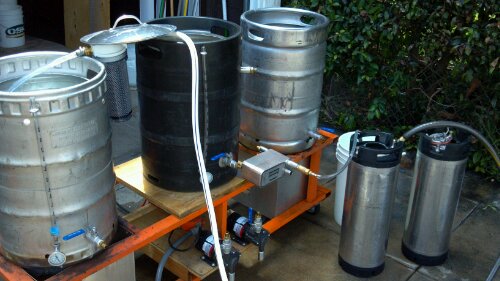
We also added another wrinkle to our operation: automated hot side aerator recirculation manifold. This addition is hoped to help in extraction of sugars and setting a good grain bed.

We also used FermCap-S in the boil kettle and in the plastic fermenters. We had two vigorous boils and no foam over. This stuff works. We are hoping it will reduce cleaning effort with the better bottle product as well.
Our 20 gallon output was split 4 ways into the fermenters with one each getting some brewer’s Clarex enzyme. This is supposed to reduce chill haze and is known to reduce gluten too. We are hoping to have some gluten intolerant friends test this for us. We will send samples to White Labs to measure the gluten levels first.
Double batch days are about 50% longer than a single day, which seems like a very good payback. We were a little tired after the 11 hour day, but not as tired as our propane tank. It got a bit frosty before we depleted it.

Our new barrel begins what we hope to be a many year journey. We filled it today with some barley wine that was aged on oak cubes and some without oak.
We plan to remove some beer every year and top off with some freshly made new product. It should be fun.

We brewed a batch of Berliner Weisse. It was a fairly straightforward affair with the only glitch being an OG miss of for points. 1.031 vs. target of 1.035.
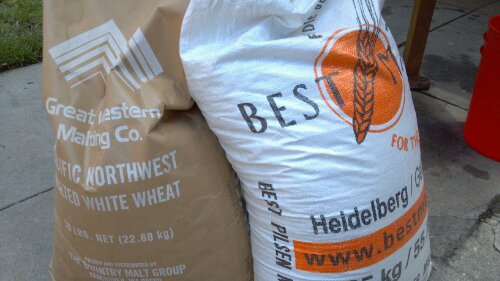
We also took delivery of a 5 gallon whisky barrel. Some of our barleywine will find a home here.

 Los Angeles Brewers