Skip navigation

Category Archives: Build


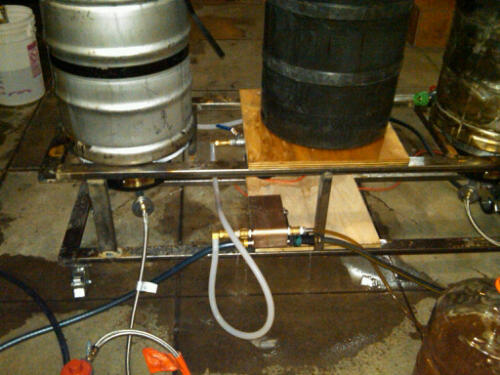
The Blickmann plate chiller is awesome.  Works like a charm.  Boiling to 67 degrees in no time at all.  Tap water was 60 degrees.  We need to work on the cooling water connections.   They are the cause of the water on the ground.

Costly, but worth it without a doubt.


I was impressed with how cold the propane tank got during the boil.  Frosty


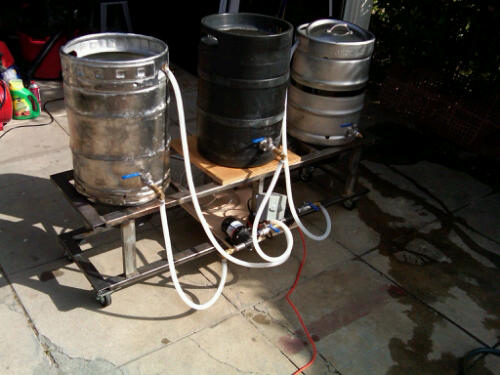
We have the brewery finished enough to brew a batch (or so we think).  The shadows are getting long, so our elaborate testing plan goes out the window.  Let’s brew!


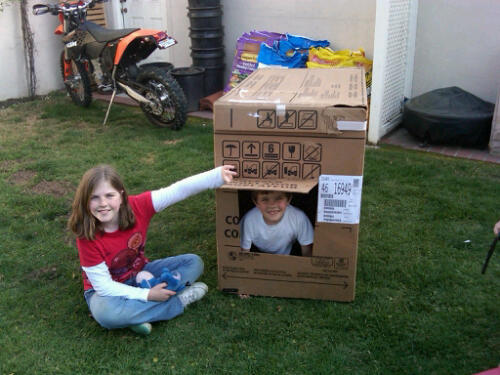
Refrigerator box fun.


We bought a freezer from Lowes (after visiting Home Depot) that we had to return.  Somehow it suffered a crushed lid at the store. It was a real bummer to get it home only to have to drive the 20 miles back to return it.  They had no more so we ordered one from Sears ($30 more but color is black).

When we went to Sears with our “pick-up is ready” email, they said that they did not have any in stock.  Fortunately, some sucker had ordered the same one and had not picked it up in two months.  Sears gave us his.

We hooked it up to the controller to get it to maintain 68 degrees.  The fermenting temp for our first recipe.


We finished the pump wiring and ran into a small problem.  The enclosure’s solution for waterproofing the switches is the little levers that move the switches via a small two-pronged fork.  One of the forks is forked.  It does not align properly and we had to open the box to get our second pump to run.


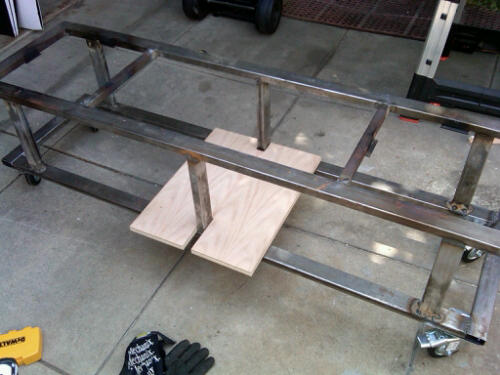
We made a huge push to finish the brewing rig and attempt to whip up a batch of beer.  We made this platform for the pumps and chiller.


We ordered three lids for our brewery.  12 inch stainless.   We got them somewhat cheap here:
http://www.csnstores.com/Nordicware-11112-NWR1038.html

We probably will not need three.


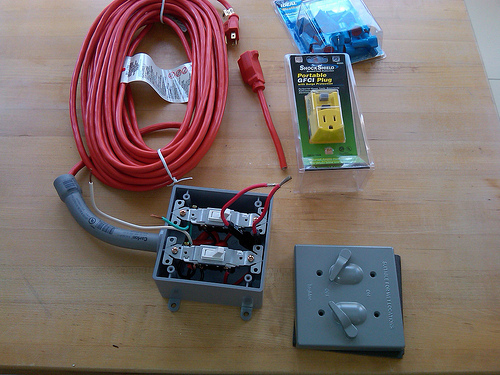
We chose to go simplistic on our switching for now.  We have decided to run the two pumps through a single box with manual switches.  The leads from the pumps are only 2 feet long, so we need to keep the box close to the pumps.  This location requires the electrical to be waterproof (or at least splash resistant).  We plan on removing the pumps from the rig when we clean, so we will pull the whole electrical off at that time too.

We started with a 50 foot, 16 gauge extension cord.  We cut the female end off and put the cut end into the box.  The two switches are hooked to the black wire to one terminal of both switches.  We put a 2.0 amp, slow blow fuse (inline housing from Radio Shack) on each of the other ends of the switches.   We will hook the fuse ends to the black on the pump wires.

We hooked the green ground to both green grounding screws on the switches and left a bit on the end to hook to the pump ground wire.

We will hook the white wire from the extension cord to both of the pumps’ white wires.  We are using weather proof wire nuts to secure all the wire to wire connections.

This should give us the ability to manually switch on or off each pump independently.  This should also be pretty safe as we have GFCI and fuse protection.

At some point in the future, we plan on implementing some kind of automation.  Maybe we can automate the pumps, fluid valves, gas valves to keep temps and efficiency in the near future.   Until then, we can get the thing going manually.
 

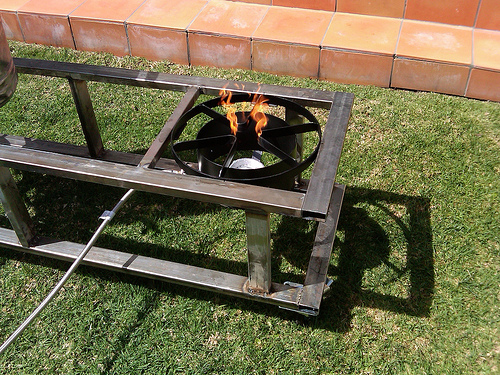
We hooked up the propane to the burners (one at a time) and cooked off the paint.  This is normal and should be done the first time you use one of these type of burners.  We put a keg 1/3 full of water on top to see if the flame hight was optimal. It looked good and got pretty hot after just 20 minutes of burn.